
Unicus Academy

Author name: ua-user

Nursery Admission 2027-28 in Kotdwar: Right Age, Readiness Signs and What to Ask a School

Nursery Admission 2027-28 in Kotdwar: Right Age, Readiness Signs and What to Ask a School Your child is almost three. Friends are already talking about nursery forms, and suddenly every conversation ends with the same question: which school, and is my child ready? This guide is written for parents in Kotdwar choosing a nursery for the 2027-28 session. It covers the age rules, the readiness signs that matter more than age, and the questions worth asking before you decide. What is the right age for nursery admission? Across India, nursery admission usually happens when a child is around 3 years old. The reason is the National Education Policy (NEP) 2020, which treats ages 3 to 8 as one “foundational stage”: three years of pre-primary (Nursery, LKG, UKG) followed by Classes 1 and 2. That structure also explains why Class 1 now starts at 6 years in most CBSE schools. If your child is 3 at nursery, they reach Class 1 at the right age without a gap or a rush.   Class Typical age at the start of the session Nursery 3+ years LKG 4+ years UKG 5+ years Class 1 6+ years At Unicus Academy, the age is calculated as on 1st January 2-27.  Age is the rule. Readiness is the real question. Two children born in the same month can be in very different places. Before nursery, look for these signs: Can stay with a familiar adult for a few hours without being very distressed Communicates basic needs: hunger, thirst, the toilet, feeling unwell Plays near or with other children, even briefly Follows a simple two-step instruction (“Pick up the ball and bring it here”) Shows curiosity: asks “what’s that?”, wants to touch, open, try Is beginning toilet training; most nurseries help with the rest If your child shows most of these, they are likely ready. If a few are still developing, that is normal. A good nursery is built to support exactly this stage. What a good nursery day should look like At three, children learn through their bodies and senses, not worksheets. A strong nursery day usually includes: Free play and movement, indoors and outdoors Circle time: songs, stories, talking and listening Hands-on early learning: sorting, counting, colours, shapes, sounds Art, music and pretend play Rest, snack and routine, so the day feels predictable and safe Be cautious of any nursery that promises reading, writing and long homework at age three. Early pressure often turns curiosity into reluctance. Why space matters more than parents expect Young children need room to run, climb, dig and explore. That is how they build balance, coordination, confidence and focus, the skills that later make sitting and learning easier. At Unicus Academy, our youngest learners grow on a 70-bigha campus with open play areas, set away from the main road and enclosed on all sides. We call this Room to Become: space for every child to try, play, discover and grow at their own pace, in line with our philosophy of Liberty in Learning. Nursery admission checklist for parents Use this list when you compare schools, including ours: Is the school CBSE-affiliated for its higher classes, so your child can continue in one place? How many children are in a nursery class, and how many adults? Is the campus enclosed, with controlled entry and CCTV? Is there a safe outdoor play space just for young children? How does the school help a child who cries during the first weeks? How will teachers share your child’s progress with you? Does the school transport cover your area? Can you visit, see a class in action and meet the teachers before deciding? Documents usually needed Most schools ask for: Child’s birth certificate Recent passport-size photographs of the child and parents Address proof Child’s Aadhaar card (if available) Immunisation record The best way to decide: visit with your child No brochure can tell you how your child will feel in a classroom. Watch how they react to the space, the teachers and other children. That is the most honest answer you will get. Book a Campus Visit · Call or WhatsApp +91 78303 84060 Frequently asked questions What is the minimum age for nursery admission in Kotdwar? Most CBSE schools take nursery admission for 3+ years. At Unicus Academy, the age is calculated as on 1st January 2027. My child was born after the cut-off date. What should I do? Talk to the school. Your child may be eligible for Pre-Nursery or may be better placed starting nursery the following session. Is there an entrance test for nursery schools? Suggested wording: There is no written test. We hold a short, friendly interaction so the child can get comfortable and we can understand them better. When do nursery admissions open for 2027-28? Registrations for the 2027-28 session are open now. Seats in each class are limited, so we recommend visiting early. My child is very shy. Will they manage? Many children are shy at three. Teachers settle them gradually with familiar routines, small groups and a gentle start.
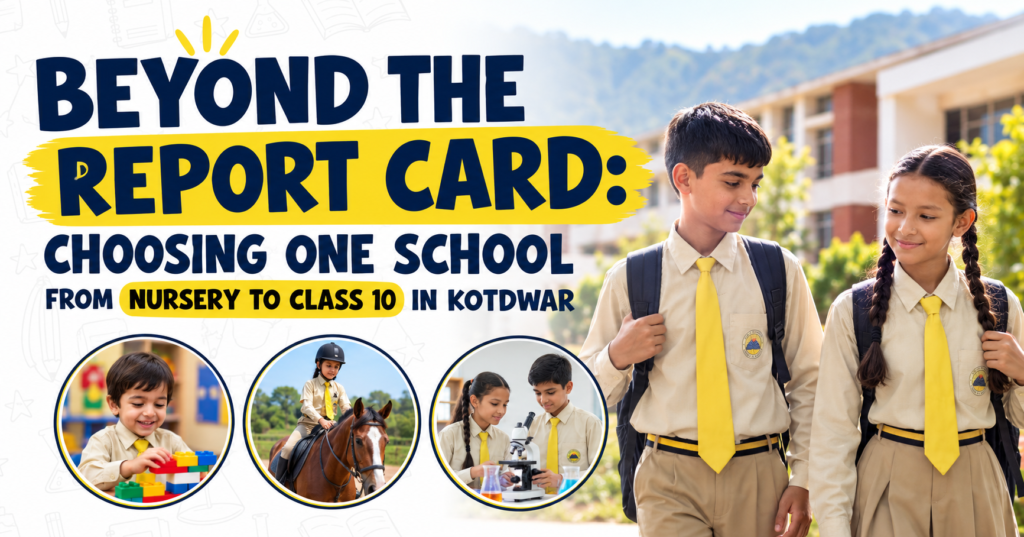
Beyond the Report Card: Choosing One School from Nursery to Class 10 in Kotdwar

Beyond the Report Card: Choosing One School from Nursery to Class 10 in Kotdwar

Beyond the Report Card: Choosing One School from Nursery to Class 10 in Kotdwar Every parent knows the late-night tab overload. It starts with “good schools near me”. Within minutes you’re looking at a dozen tabs: similar buildings, the same promises of “holistic excellence” and stock photos of smiling children with notebooks. Finding options isn’t the hard part. Seeing past the slogans to the place where your child will actually thrive is. If your child joins nursery school at three, they may spend the next 13 years in one school. That school will shape whether they treat mistakes as failures or lessons, whether they speak up with confidence and whether their curiosity survives the run-up to board exams. This guide looks at what children need at each stage, from nursery to Class 10, and how to choose a school that can grow with them. Why choosing for the long run matters Changing schools is hard on children. New friends, new teachers and new rules take time, and learning often dips while they settle. Choosing a school that can carry your child from the early years to the board years means fewer disruptions and teachers who know them well. So when you compare schools, don’t only ask “Is this right for my child now?” Also ask “Will this still be right in Class 6, and in Class 10?” What your child needs at each stage Stage Age What matters most What to see on a visit Nursery to UKG 3–6 Play, movement, language, feeling safe Open play space, hands-on materials, warm teachers Classes 1–5 6–11 Strong basics, curiosity, confidence to speak Children explaining why, real work on the walls Classes 6–8 11–14 Deeper subjects, labs, independence, interests Labs in regular use, sports and arts in the timetable Classes 9–10 14–16 Board preparation, study habits, steady guidance Teacher support and balance, not panic 1. The early years: discovery before drills Children aged three to six don’t learn by sitting still and tracing worksheets for hours. They learn through their senses, their bodies and feeling secure. India’s NEP 2020 recognises this by treating ages 3 to 8 as one foundational stage built on play and activity. When you look at a nursery, pre-school or kindergarten, look for: Hands-on learning: letters and numbers through objects, stories and play, not rote drills Teachers who notice every child, including the quiet ones A gentle start: songs, games and routines that make drop-offs easier Space to move: safe outdoor play every day At Unicus Academy, our youngest learners grow on an approximately 70-bigha campus, enclosed and set away from the main road. There is room to run, explore and play: Room to Become. 2. The primary years: understanding the “why” Around Class 1, many classrooms shift towards memorising. Children learn to get the tick on the page but can’t always use the idea outside it. When you compare primary schools, look past the homework diary: Learning by doing: maths and science linked to activities and practical work Confidence to speak: discussions, storytelling and chances to present, especially for shy children A balanced week: art, music, sport and computers scheduled alongside core subjects, not squeezed in at the end This is our philosophy, Liberty in Learning: guided freedom within a structured, caring environment. At Unicus, primary children learn in interactive classrooms and use our Mathematics Labs, Science Lab, Computer Lab and library as part of their regular week.  3. Classes 6 to 10: preparing for the board years without the pressure This is where many parents start searching for “high schools near me”. Subjects get deeper and Class 10 boards come into view. The worry is real: how do you protect marks and your child’s well-being? Strong board results don’t come from fear. They come from clear concepts, good study habits and teachers who guide steadily from Class 6, not only in Class 10. Look for: Concepts first: subjects taught so children understand, not only memorise for the exam Practical work: regular, hands-on time in the science and computer labs Steady guidance: teachers who track each student and step in early Balance: sport, music and performance that continue through the board years, not stop At Unicus, sport stays part of school life as children grow. Horse riding, shooting, skating, football, basketball, martial arts, yoga and dance build focus, discipline and resilience, the same qualities exam years demand. We call it Train the Body. Build the Mind. Questions to ask on your campus visit “How many students are in a class in the early years, primary and middle school?” “How often do students use the labs, and what do they do there?” “Do sports and arts continue in Classes 9 and 10?” “How do teachers support a student who is falling behind?” “How often will I hear about my child’s progress?” Unicus Academy at a glance     Classes CBSE curriculum, Nursery to Class 10 Campus Approximately 70 bighas, enclosed, away from the main road, CCTV, announcement system across sections Academic spaces Interactive classrooms, Science Lab, Mathematics Labs, Computer Lab, library Sports Horse riding, shooting, skating, football, basketball, martial arts, yoga, dance Creative spaces Music Room, Art and Craft Studio, Amphitheatre Location Lachhampur, Haldukhata (near Govt. Polytechnic / Kanvaghati), Kotdwar, Pauri Garhwal, Uttarakhand 246149 Frequently asked questions Does Unicus Academy have classes up to Class 10? Yes. Unicus follows the CBSE curriculum from Nursery to Class 10.  Is it better for my child to stay in one school from nursery to Class 10? For most children, yes. Fewer moves mean steadier friendships, teachers who know them well and fewer gaps in learning. Will sports affect my child’s studies in the board years? Planned well, no. Regular exercise improves focus and helps students manage exam stress. Is the campus far from Kotdwar? The campus is near Kanvaghati, away from the main road, which gives children a quieter, greener and safer setting.  Walk the campus before you decide Directory listings and brochures can only tell you so much. Walk the

Choosing the Right School for Your Child in Kotdwar: A Parent’s Guide from Nursery to Primary

Choosing the right school in Kotdwar, Parent’s Guide Choosing the Right School for Your Child in Kotdwar: A Parent’s Guide from Nursery to Primary When your child is three, their world feels wonderfully small. You know every scraped knee, every favourite story and the exact laugh that means mischief is coming. Then admission season arrives. Suddenly there are open browser tabs, school suggestions in every family WhatsApp group and late-night searches for “good schools near me”. It’s easy to judge a school by its building or brochure. But you are really choosing the place where your child will make their first friend, ask their first difficult question and learn to get up after a fall. This guide is for Kotdwar parents choosing a school from Nursery through the primary years. It covers what matters at each stage, a 7-point checklist and the questions worth asking on a campus visit. Why the early years matter so much The years from 3 to 8 are when children build the habits that shape how they learn for life. India’s National Education Policy (NEP) 2020 recognises this by treating these years as one foundational stage: three years of pre-primary (Nursery, LKG, UKG) followed by Classes 1 and 2. At this age, children learn by doing, touching, moving and talking, not by memorising. When they have space to explore and feel safe to try, they build three strengths: Flexible thinking: knowing a problem can be solved more than one way Social confidence: taking turns, sharing and expressing feelings in words Love of learning: seeing school as an adventure, not a chore Nursery, pre-school and kindergarten: what a good start looks like On paper, every pre-school and kindergarten looks similar. In person, the differences are easy to see if you know what to look for. In a nursery or pre-school, look for warmth before worksheets: Hands-on spaces: blocks, sand, art materials and picture books, not rows of desks Teachers who get down to eye level and listen, not just supervise Gentle settling-in: predictable routines that help a child through the first tearful weeks Room to move: safe outdoor space where little children can run, climb and play every day In kindergarten (LKG and UKG), play becomes more purposeful. Children start early reading and numbers, but through counting real objects, rhymes, stories and patterns. Real understanding comes before the pencil. At Unicus Academy, our youngest learners begin on an approximately 70-bigha campus, enclosed on all sides and set away from the main road. That space is part of how they learn: room to run, explore, try and grow. We call it Room to Become. Primary school: raising thinkers, not just test-takers From Class 1, at age six under NEP 2020, the focus shifts. Parents start comparing boards and searching for “CBSE schools near me”. A CBSE curriculum gives a dependable national framework. But the board sets the syllabus; the school decides how it is taught. When comparing primary schools, look for three things: Understanding over memorising. Can children explain why an answer works, and connect it to everyday life? Confidence to speak. Are there regular chances to present, perform and discuss, for every child and not only the confident ones? A balanced day. Sport, art, music, library time and technology should sit alongside maths, science and languages, not after them. This is the idea behind our philosophy, Liberty in Learning: guided freedom within a structured, caring environment. At Unicus, academics are serious, and every child also gets regular, coached time on the field, in the lab and on stage. 7 things to check before choosing a school # What to check What to look for Why it matters 1 Safety Enclosed campus, controlled entry, CCTV, supervised dispersal and transport Children learn only when they feel safe 2 Teachers How teachers speak to children in informal moments Warmth and patience make children willing to ask and try 3 Classroom walls Real children’s work, not perfect adult-made displays Shows everyday learning is genuine 4 The journey Total travel time and supervision on the bus A calm, predictable commute protects a young child’s energy 5 Communication How often and how openly the school talks to parents Good schooling is a partnership 6 Handling mistakes What happens when a child gives a wrong answer in class Kind correction builds resilience 7 Facilities in use Are labs, libraries and playgrounds busy during the school day? Facilities only help if children actually use them How Unicus Academy measures up What parents check At Unicus Academy Classes CBSE curriculum, Nursery to Class 10 Space Approximately 70-bigha campus with large playgrounds Safety Enclosed campus away from the main road, CCTV, announcement system across all sections Learning spaces Science Lab, Mathematics Labs, Computer Lab, library, interactive classrooms Sports Horse riding, shooting, skating, football, basketball, martial arts, yoga, dance Creative spaces Music Room, Art and Craft Studio, Amphitheatre Transport localities covered, Sigaddi, Saneh, Kotdwar Market Questions to ask on a campus visit “How many children are in a class, and how many teachers or helpers?” “How do teachers handle a conflict on the playground?” “How much time do children spend playing outdoors each day?” “What support is there for a child who needs more time with a concept?” “How will you keep me updated on my child’s progress?” Ask us these at Unicus. We’d rather you leave with honest answers than a brochure. Frequently asked questions At what age should my child start nursery? Most CBSE schools take nursery admission at 3+ years, so the child reaches Class 1 at 6 as NEP 2020 recommends. At Unicus, age is calculated as on 1st January 2027. How do I choose between nearby CBSE schools? The syllabus is the same across CBSE schools. Compare how it is taught, teacher continuity, attention per child, sport and creative time, safety and communication with parents. What is the difference between pre-school and kindergarten? Pre-school (playgroup and nursery) focuses on play, movement, social skills and independence. Kindergarten (LKG and UKG) gently introduces

Scroll to Top