
Beyond Rote Learning: Bringing the NEP Vision to Life at Unicus Academy
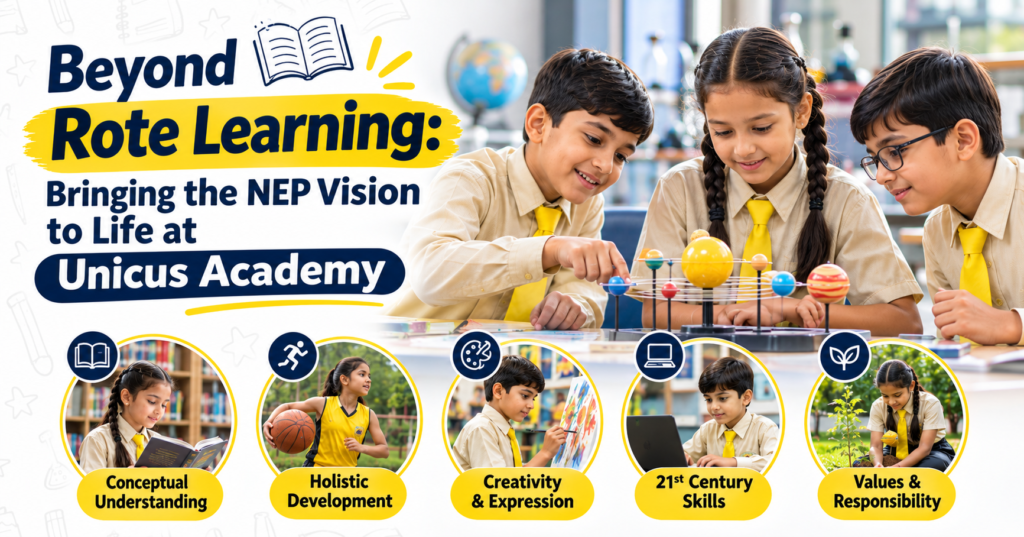
Beyond Rote Learning: Bringing the NEP Vision to Life at Unicus Academy
Consider what happens in any professional field.
An engineer does not build a reliable bridge by merely memorizing structural definitions from an engineering manual. An architect does not design an enduring home by reciting formulas about load distribution. They examine materials, test stress limits, observe how components fit together, and refine their work through direct practice.
Yet for decades, standard schooling has measured a child’s intellect on a single metric: temporary memorization of textbook answers.
A student reads a fixed definition of an electrical circuit or the timeline of a historical event. They copy it into their notebook, reproduce it onto an examination paper, and receive a high score. A few weeks later, when the test has passed, that information is almost entirely gone.
This model prepared students for an earlier era where administrative tasks required copying records and following fixed procedures. In today’s world, any smartphone can look up a scientific formula, historical date, or mathematical definition in three seconds. Memorization alone is no longer an advantage.
The modern world rewards individuals who can analyze unfamiliar challenges, evaluate evidence, collaborate effectively, and develop practical solutions.
The National Education Policy (NEP) was introduced to replace outdated rote memorization with conceptual, application-based learning. While many schools have simply added the phrase “NEP Aligned” to their admission prospectuses, Unicus Academy in Kotdwar built its daily academic routine entirely around this principle.
We do not train students to memorize ready-made conclusions. We teach them how to observe, question, and understand.
Moving from Memorization to Genuine Mastery
Transitioning away from rote learning requires reimagining how teachers instruct and how students demonstrate true understanding.
The Conventional Rote Model
The Unicus Experiential Approach
Memorize First: Read definitions and recite lines word-for-word
Investigate First: Observe how things work before learning formal theory
Isolated Subjects: Subjects confined to separate, isolated periods
Integrated Projects: Subjects combined to solve real challenges
Penalizing Errors: Incorrect answers penalized with low marks
Analyzing Mistakes: Errors treated as helpful data to refine thinking
Passive Listening: Quietly copying notes from a board
Active Participation: Students discuss, test, and explain their ideas
Three Core Ways Learning Works at Unicus Academy
1. Direct Observation Precedes the Formula
In traditional schools, students are often handed an abstract scientific equation on a board and asked to memorize it for an upcoming quiz. To a young learner, these symbols often feel disconnected from reality.
At Unicus Academy, instruction begins with direct observation:
Physical Mechanics: Before calculating mechanical advantage or lever ratios, students work with balanced weights, pulleys, and pivot points on our grounds. They observe firsthand how shifting a pivot reduces the effort needed to balance a weight. Once their eyes and hands register the physical principle, the mathematical equation becomes a clear, logical description of what they have already seen.
Biological Sciences: Instead of copying two-dimensional diagrams of plant vascular systems from a textbook, students work in our campus discovery gardens. By placing white flowers into tinted water and observing how color travels upward through the stem over several hours, students see fluid transport happen before their eyes. The scientific terminology becomes permanent because it is anchored in direct observation.
Economics and Trade: Rather than memorizing definitions of supply, demand, and resource distribution, students participate in a structured classroom trade simulation. They manage resources, navigate shifting availability, and observe how value changes when materials become scarce.
When students see how a concept operates in the real world, learning requires no artificial cramming. Understanding is lasting because it is grounded in direct experience.
2. Connecting Disciplines to Solve Practical Challenges
In professional life, challenges never arrive neatly categorized by school subject.
When a civil engineer plans a regional water management system, they cannot say, “I only handle calculations; someone else must evaluate the soil quality, analyze local climate records, and draft the municipal report.” Real-world projects require applying mathematical logic, scientific principles, and articulate communication simultaneously.
Standard schooling, however, breaks a child’s day into separate, forty-minute blocks: mathematics in the morning, a bell rings, geography in the next period, another bell rings, followed by language.
At Unicus Academy, students participate in Integrated Project Modules.
For example, middle-school cohorts study local environmental design by planning an eco-efficient water catchment model suited for the Kotdwar terrain:
Applied Mathematics: Students measure catchment surface areas and calculate precipitation volume based on regional rainfall data.
Environmental Science: They build and compare water filtration models using sand, gravel, and charcoal layers, testing clarity and filtration speed.
Communication: Teams draft a structured project overview and present their design to their instructors and peers.
This cross-disciplinary approach answers the common question students ask: “Why do I need to learn this?” Knowledge stops feeling like a chore for an exam—it becomes a reliable tool to solve meaningful problems.
3. Treating Errors as Practical Learning Data
In conventional classrooms, mistakes on assignments are frequently marked with heavy red ink, lower marks, and public embarrassment.
This creates an unhelpful habit: students become afraid to take intellectual risks. They avoid asking challenging questions, stick strictly to the safest answers, and memorize standard lines to protect their grades.
At Unicus Academy, mistakes are treated as normal, constructive steps in problem-solving.
When an engineering model does not hold weight, or when an experiment yields unexpected data, our faculty do not simply mark it wrong. They review the process alongside the student:
Where did the original hypothesis differ from the observed outcome?
Which measurement or variable caused the result to shift?
How can the structure or plan be adjusted to make it stronger?
This deliberate analysis builds intellectual resilience. Students discover that an initial mistake is not a dead end, but a natural step toward a better solution. They develop the patience, tenacity, and logical clarity required to tackle complex problems with confidence.
The Unicus Standard: Fostering Independent Thinkers
Walk through our Kotdwar campus on an ordinary academic morning, and you will not see quiet classrooms where students spend their day copying paragraphs off a board.
Instead, you will see an active, purposeful learning environment where students:
- Formulate clear questions rather than waiting for scripted answers.
- Articulate and support their viewpoints during group seminars.
- Apply academic knowledge directly to practical projects.
- Approach new challenges with curiosity, focus, and quiet confidence.
These foundational abilities prepare students for high academic performance, top university environments, and professional leadership.
A High-Value Educational Investment
Every parent wants to provide their child with an education that prepares them for long-term success.
True academic achievement does not come from memorizing answers for short-term tests. It comes from cultivating a disciplined mind that knows how to think, analyze, and build under any set of circumstances.
You can leave your child in a system focused on rote memorization drills.
Or you can choose Unicus Academy—where the core principles of the National Education Policy are practiced every day, giving your child the insight, capability, and character to excel.
Admissions Open for Session 2027–28
Visit our Kotdwar campus during normal school hours. Tour our learning grounds, meet our academic faculty, and see how our experiential approach brings education to life.
- Admissions Office:+917830384060
- Location : Darshini Marg, Lachampur, Post office – Kanvaghati, near Govt. Polytechnic College, near Kanvaghati Kotdwar, Haldu Khata, kotdwar, Uttarakhand 246149
- Give your child an open horizon. Secure their seat at Unicus Academy today.