
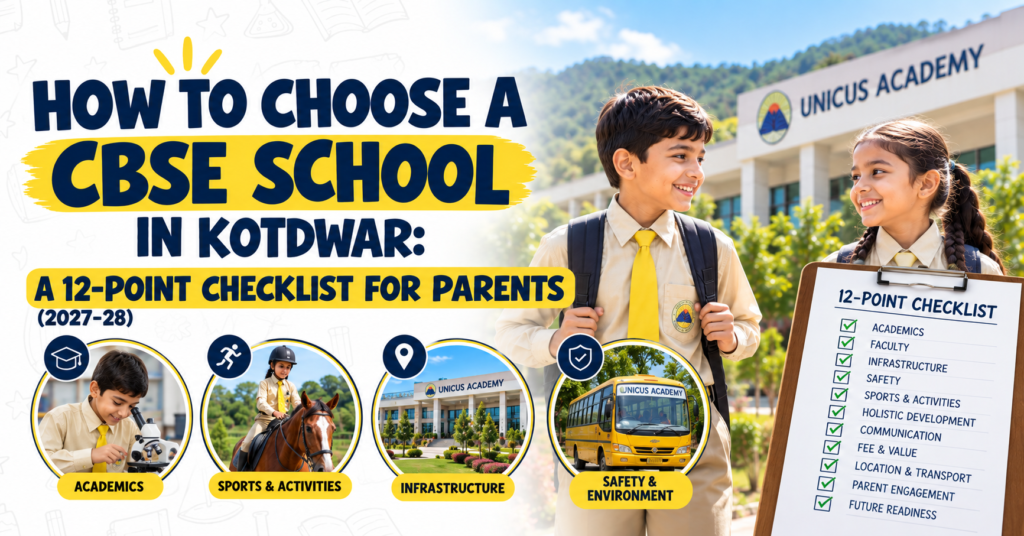
Every parent in Kotdwar has heard the same advice: “Choose a good CBSE school.” But what does “good” actually mean when every school says it offers quality education, values and all-round development?
This checklist gives you 12 practical things to check. Use it for any school you are considering, including ours. Most of them can only be judged properly by visiting.
Why parents choose CBSE
CBSE is a national board. Its curriculum carries across India, which helps families who may move cities. It also aligns closely with NCERT books and national entrance exams, and it is moving steadily towards NEP 2020’s focus on understanding, skills and activity-based learning.
The board sets the syllabus, though. The school decides how it is taught. That is what this checklist helps you judge.
The 12-point checklist
Part A: Learning
- Affiliation and continuity. Confirm the school’s CBSE status in its Mandatory Disclosure. Check how far the school goes, so your child doesn’t have to switch schools early.
- How lessons are taught. Ask to see a class. Are children asking questions and doing things, or only copying from the board?
- Teachers. Ask about teacher qualifications, training and how long teachers usually stay. Continuity matters for young children.
- Attention per child. Ask how many children are in a class and how the school supports a child who falls behind or races ahead.
- Labs and library in use. Every school lists a Science Lab. Ask when your child’s class actually uses it, and how often they borrow library books.
Part B: The whole child
- Sports with real coaching. Look for regular, coached sessions, not one games period a week. Sport builds focus, teamwork and resilience.
- Space to move. Children need room to run and play every day. Check the size and safety of the playgrounds.
- Creative and speaking opportunities. Look for music, art, stage performance and chances for every child, not just the confident ones, to speak in front of others.
Part C: Safety and practicalities
- Campus safety. Is the campus enclosed? Who controls entry? Is there CCTV? How are children supervised during breaks and at dispersal?
- Commute and transport. Check the route, travel time and supervision on the bus. A calm, predictable journey matters, especially for young children.
- Communication with parents. How often will you hear from teachers? How are concerns handled, and how quickly?
- The feel of the school. Do the children look happy and engaged? Do teachers greet them by name? Trust what you see.
Questions to ask on a campus visit
- “Can I see a class in progress for my child’s age?”
- “What does a typical day look like, from arrival to dispersal?”
- “How do you handle a child who is struggling, academically or emotionally?”
- “Which activities will my child do every week, and who coaches them?”
- “How will you keep me informed about my child’s progress?”
How Unicus Academy answers this checklist
We built Unicus around a simple belief: children become more when they have room to experience more. Our philosophy is Liberty in Learning, which means guided freedom within a structured, caring environment.
Checklist area | At Unicus Academy |
Continuity | CBSE curriculum, Nursery to Class 9th( to be upgraded to 12th) |
Learning spaces | Science Lab, Mathematics Labs, Computer Lab, library, interactive classrooms |
Sports | Horse riding, shooting, skating, football, basketball, martial arts, yoga, dance |
Creative spaces | Music Room, Art and Craft Studio, Amphitheatre |
Space to move | Approximately 70-bigha campus with large playgrounds |
Safety | Enclosed campus away from the main road, CCTV, announcement system across sections |
We don’t ask parents to take our word for it. We ask them to come and see.
See it for yourself
Bring this checklist to Experience Unicus Day, held every month. Walk the campus, watch a class and a practice session, and ask our teachers anything.
Book a Campus Visit · Call or WhatsApp +91 78303 84060
Frequently asked questions
What should I look for in a good CBSE school?
Check how lessons are taught, teacher continuity, attention per child, regular sport and creative activity, campus safety, transport and communication with parents.
Is a bigger campus really better?
Space alone doesn’t make a school good, but it matters. Children who move, play and explore every day tend to be more focused and confident in class.
Are sports a distraction from academics?
Not when they are planned well. Coaching sports builds discipline, concentration and resilience, which support learning.
How many schools should I visit before deciding?
Visit at least two or three, ideally with your child, and use the same checklist at each.
Does the school need to be close to home?
A short, safe commute helps. For many families, a school with better space and safety is worth a slightly longer, well-supervised journey.